
How We Built a Sci-Fi Security Dashboard: 20 Years From LKM IDS to AI Defense
Twenty years ago, defending a server meant writing your own eyes and ears into the kernel. Today it means teaching a machine to read a million log lines and tell you which twelve of them matter. This is the story of the new LightUp.Cloud security dashboard — and the two decades of intrusion-detection work that shaped it.
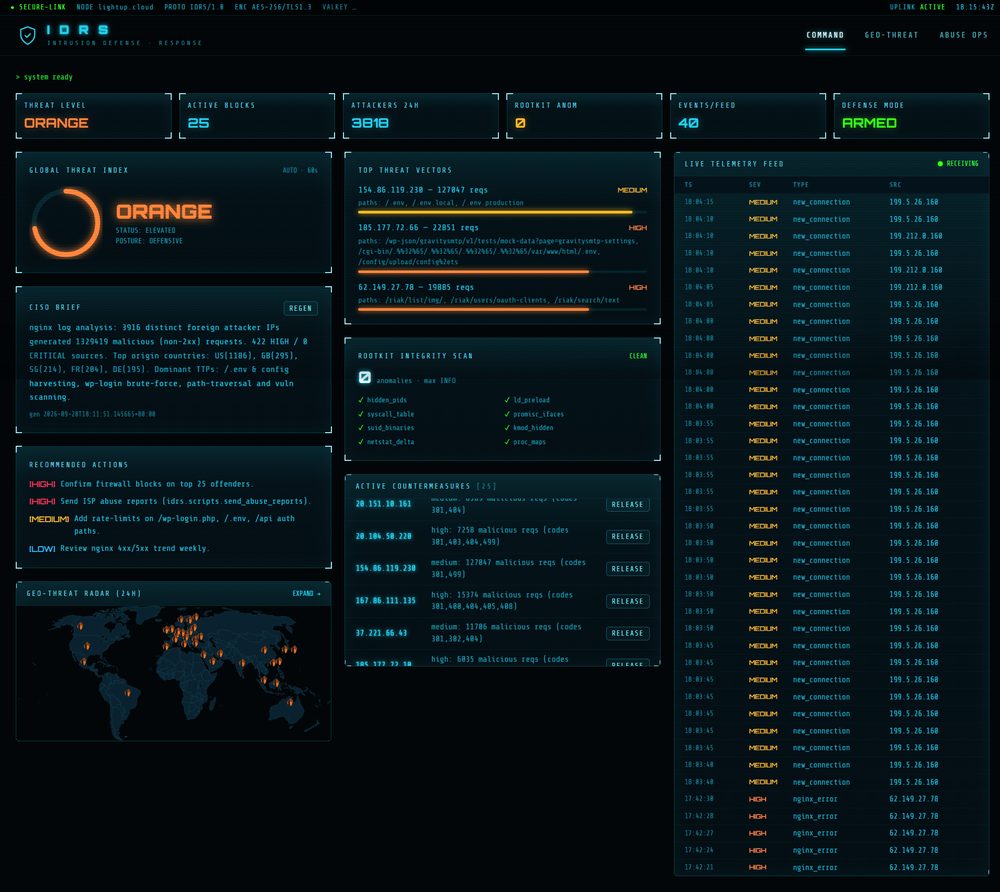
The IDRS command console: live threat level, geo-threat radar, rootkit integrity scan and a real-time telemetry feed.
The Old Way: A Detector Inside the Kernel
My first intrusion-detection system was a Loadable Kernel Module. Back then, if you wanted to see what an attacker was really doing, you hooked the syscall table — open, execve, ptrace, the socket calls — and watched from inside the kernel where nothing could hide from you. It was powerful and terrifying in equal measure: one bad pointer and the whole box panicked. You learned to respect the machine.
That era taught the lesson that still underpins everything we build: detection has to live close to the truth. Logs lie by omission, user-space daemons can be killed, but the kernel sees every process that is really running and every packet that really arrives. Rootkit authors knew this too — which is why the same techniques we used to detect them were the techniques they used to hide. The arms race was intimate and technical.
What Changed: The Volume Problem
The signatures-and-syscalls approach had a ceiling, and we hit it hard. Modern attackers do not send one clever exploit; they send a flood. A single week of our nginx logs is over two million requests, a million and a half of them non-2xx probes: /.env harvesting, wp-login.php brute-force, /cgi-bin/ path-traversal, credential stuffing from a rotating cast of cheap cloud VMs. No human reads that. No static ruleset keeps up with it either — the payloads mutate faster than you can write regexes.
The problem stopped being detection and became triage. Out of a million events, which handful represents a real, coordinated threat worth acting on? That is a language problem as much as a security one — and language is exactly what modern AI is good at.
The New Way: AI as the Analyst That Never Sleeps
The dashboard above is the front end of IDRS — our Intrusion Detection & Response System. Underneath it, a local large-language model runs entirely on our own hardware (no customer data ever leaves the box) and does the job a tired SOC analyst would do at 3 a.m., except continuously and without missing anything. It reads the normalized event stream, clusters related activity, assigns severity, and writes a plain-English brief a human can act on in seconds.
Running the model locally is a deliberate choice. Sending your security telemetry to a third-party AI API would mean shipping the very data you are trying to protect to someone else's cloud — the opposite of everything LightUp stands for. The model server is bound to loopback only; it is never reachable off-box.
Reading the Console
Every panel exists to answer a question a defender actually asks:
Global Threat Index — one glance tells you the posture: GREEN, YELLOW, ORANGE, RED. The gauge is driven by real block counts and severity, not vibes.
Geo-Threat Radar — every hostile source is plotted on a world map as a clawing hand rising from its country of origin, sized by attack volume. It is theatrical on purpose: a wall of zombie hands reaching out of Asia, Europe and North America communicates "you are under constant automated assault" far faster than a table of IP addresses ever could. The map is rendered server-side; it makes zero external tile requests.
Top Threat Vectors — the worst offenders with their real request counts and the exact paths they hit, so you can see the intent (secrets harvesting, RCE attempts, scanning) at a glance.
Rootkit Integrity Scan — a nod to where this all began: hidden PIDs, LD_PRELOAD tricks, syscall-table tampering, promiscuous interfaces. The kernel-level checks from twenty years ago, now just one panel among many.
Active Countermeasures & Live Telemetry — what the system has already done (IP blocks, with one-click release) and what is happening right now, streamed live over SSE.
Detection Is Half the Job — Response Is the Other Half
An IDS that only watches is a smoke detector with no sprinklers. IDRS closes the loop: it can block source IPs, null-route ranges, lock accounts, and — the step most teams skip — report the attackers to their providers. The system groups offending IPs by hosting provider, resolves each one's abuse contact, and composes an evidence-bearing abuse report listing every IP and the malicious requests it sent. As we argued years ago in our DDoS write-up, the abuse-report route is unglamorous but genuinely effective: most legitimate providers would rather clean up their network than knowingly host a botnet.
Twenty Years, One Principle
The tools changed beyond recognition — from a hand-written kernel module to a local LLM reasoning over a live event stream — but the principle did not. Stay close to the truth, act on what matters, and keep the data under the customer's control. The kernel module taught us the first part. Two decades of running real infrastructure under real attack taught us the rest. AI simply lets us do it at a scale that would have been unthinkable when we started.
At LightUp.Cloud, security is not a bolt-on dashboard for show. It is the same instinct that made me hook the syscall table in 2005, expressed with the best tools 2026 has to offer.
Related reading
- What to Do When Kids Launch a DDoS Attack on Your Website — the abuse-report playbook that inspired the automated reporting pipeline.
- Looking Back: When We Thought Cybersecurity Was the Future — the long arc of our security work.
- Discouraging the Usage of Spamhaus.org — an early lesson in trust, evidence and abuse handling.
- Dangers of the Clouds — why we keep detection and data on-box.
- OpenSearch as a RAG Backend — more on the AI infrastructure behind our products.